
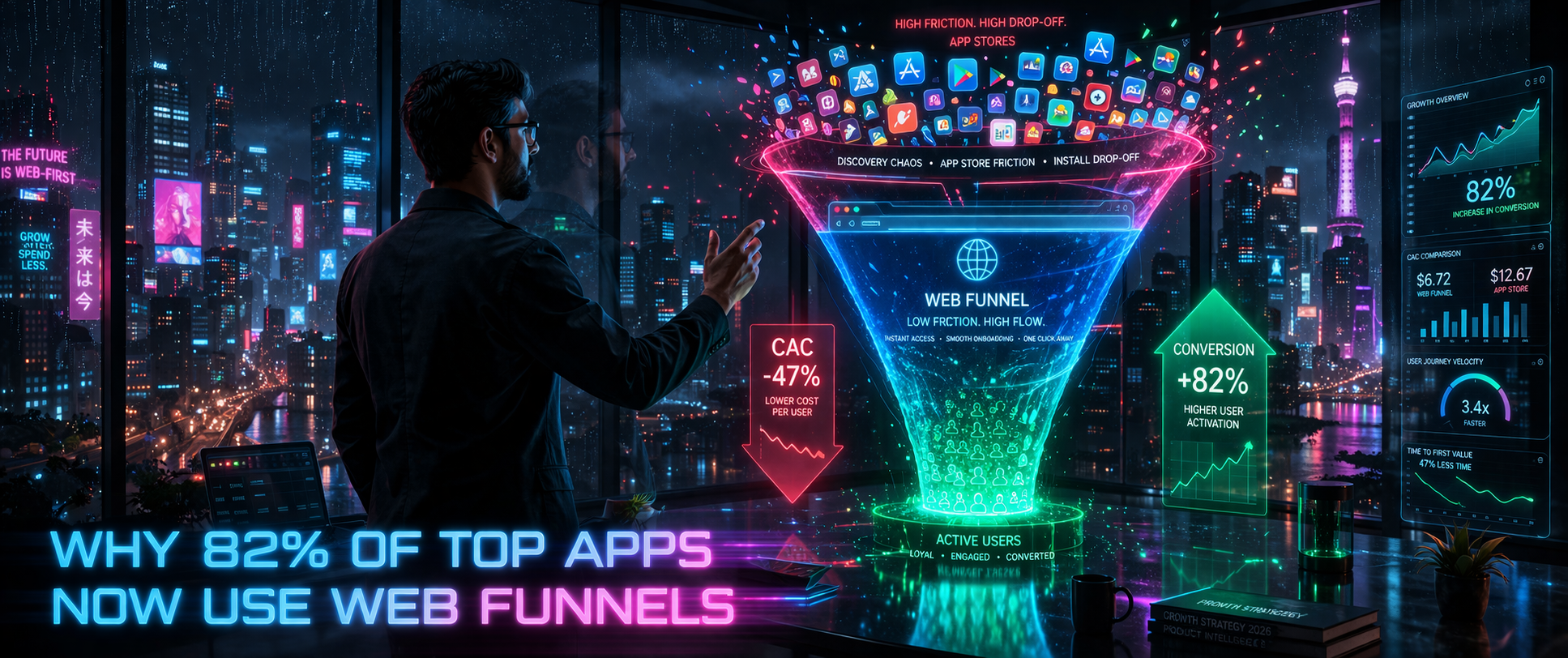

The landscape of mobile user acquisition has shifted fundamentally. While the "App Store First" mentality dominated the previous decade, 2026 data indicates a massive migration toward web funnels. Currently, a significant majority—approximately 82% of top-grossing non-gaming apps—utilize a web-based entry point before a user ever hits the "Install" button.
This transition isn't just a trend; it is a response to the escalating costs of traditional App Store Search Ads (ASA) and the restrictive privacy frameworks that have made direct-to-store attribution increasingly difficult. For developers and founders, understanding the mechanics of the web funnel is no longer optional—it is the baseline for sustainable growth.
The Problem: The "App Store Friction" Tax
In the early 2020s, the standard journey was simple: Ad → App Store → Install → Sign Up. However, this path contains several "drop-off" points that bleed marketing budgets:
- The Store Decision: Users must decide to commit storage space and data before even seeing the product's value.
- The Identification Gap: Attribution on iOS (via SKAdNetwork) remains less granular than web-based tracking.
- The Payment Barrier: Apple and Google’s 15–30% commission on in-app purchases (IAP) significantly eats into margins for digital services.
By 2026, the cost per install (CPI) in competitive verticals like Fintech or Health & Fitness has reached levels that make direct store acquisition unsustainable for many. Web funnels solve this by moving the high-intent actions—quizzes, personalization, and even payment—into the mobile browser.
Strategic Framework: How Web Funnels Work in 2026
The modern web funnel operates on a "Value-First, Install-Last" logic. Instead of asking for a download, the brand asks the user to solve a problem.
1. The Personalization Hook
Top apps now lead with interactive web content. For example, a fitness app might offer a "30-Second Biological Age Quiz." Because this happens in the browser, there is zero friction. The user provides data, seeing immediate "results" or a "custom plan."
2. The Conversion Event (The "Web Pay" Model)
This is where the 82% statistic becomes most relevant. By processing the initial subscription on the web, companies avoid the "App Store Tax." In 2026, users are highly accustomed to "Web Pay" flows, often preferring them for the ease of using saved browser credentials or alternative payment methods like crypto or regional fintech wallets.
3. The Seamless Transition (Deferred Deep Linking)
Once the user has paid or signed up on the web, they are prompted to download the app to "access their results." Using deferred deep linking, the app opens directly to the user’s personalized dashboard, bypassing the generic "Welcome" screen.
Implementation: Moving Your Growth Strategy to the Web
If you are currently managing Mobile App Development in Maryland or any regional tech hub, your roadmap must include a web-based acquisition layer. Implementation requires a specific technical stack to ensure the transition from browser to app is invisible to the user.
Step 1: Optimized Landing Infrastructure
Your web funnel must load in under 1.5 seconds. In 2026, Google’s "Core Web Vitals 4.0" heavily penalize slow-loading interactive elements. Use server-side rendering (SSR) for your quizzes to ensure the user stays engaged.
Step 2: Attribution Alignment
Use a unified attribution partner (like AppsFlyer or Adjust) to bridge the gap. You need to know that "User A" who clicked a Meta ad and finished a web quiz is the same "User A" who just opened the app for the first time.
Step 3: The "Hook" Design
Don't just replicate your app on the web. The web funnel should be a "lite" version or a diagnostic tool. For more complex projects involving generative elements, refer to this AI features in mobile apps complete guide 2026 to see how to integrate thin-client AI tools into your web onboarding.
Real-World Examples
Hypothetical Scenario: The Wellness App "Voda"
- The Strategy: Voda shifted 90% of its budget from App Store Ads to a web funnel featuring a "Stress Profile Analysis."
- The Result: They achieved a 40% reduction in CAC because the web quiz allowed them to optimize Facebook ads for "Quiz Completion" rather than "App Install," which provided the algorithm with more frequent data signals.
- The Outcome: Because users paid $29.99 on the web before downloading, Voda kept $29.99 (minus stripe fees), rather than $20.99 after Apple’s cut.
The SaaS Pivot: "ProjectFlow"
ProjectFlow, a B2B productivity tool, found that expert users hated the App Store interface for initial setup. By moving the workspace configuration to a web funnel, they increased Day-1 retention by 22% because the app was "ready to work" the moment it was opened.
AI Tools and Resources
Branch.io — Industry standard for deep linking and web-to-app attribution
- Best for: Ensuring a seamless user transition from a web payment page to a specific in-app screen
- Why it matters: Eliminates "contextual break" where users have to log in again after downloading
- Who should skip it: Small apps with purely organic growth and no paid funnels
- 2026 status: Fully integrated with 2026 privacy protocols for iOS 19/20
Typeform AI (Pro) — AI-driven form and quiz builder for web onboarding
- Best for: Creating the "Hook" phase of the web funnel without custom coding
- Why it matters: Dynamically adjusts questions based on user sentiment to maximize completion rates
- Who should skip it: High-security fintech apps requiring custom-encrypted data entry
- 2026 status: Now features native predictive analytics for conversion probability
RevenueCat — Subscription management that bridges web and app
- Best for: Handling the "Web Pay" model and syncing entitlements to the mobile app
- Why it matters: Simplifies the complex logic of checking if a web-subscriber has access inside the app
- Who should skip it: Apps with a strictly one-time purchase or ad-based revenue model
- 2026 status: Includes automated 2026 tax compliance for global "Web Pay" transactions
Risks, Trade-offs, and Limitations
While the data supports the web funnel move, it is not a "silver bullet." It introduces new technical complexities that can break the user experience if handled poorly.
When Web Funnels Fail: The "Leaky Bucket" Transition
A user completes a 10-minute quiz on the web, pays for a subscription, and is told to "Download the App." When they open the app, they are met with a blank login screen and have to re-enter all their data or, worse, their payment isn't recognized.
- Warning signs: High "Install-to-Open" drop-off; customer support tickets claiming "I paid but can't get in."
- Why it happens: Failure to implement server-to-server (S2S) event pings. The app doesn't "know" the user has already converted until a slow database sync occurs.
- Alternative approach: Implement real-time WebSocket notifications or a "Magic Link" sent via email/SMS immediately upon web payment to force-verify the app session.
Key Takeaways
- Web funnels are the 2026 standard for reducing CAC and bypassing the "App Store Tax."
- Prioritize the browser experience for personalization and payment; reserve the app for the core utility and retention.
- Attribution is the backbone. Without a tool to link web clicks to app opens, you are flying blind.
- Don't ignore the App Store entirely. It remains a powerful discovery engine, but it should no longer be your primary conversion funnel.
The shift toward web-first acquisition reflects a more mature mobile ecosystem where the browser is the "lobby" and the app is the "destination." By 2026, those who insist on forcing users through the App Store front door are simply paying a premium for higher friction.



Top comments (0)